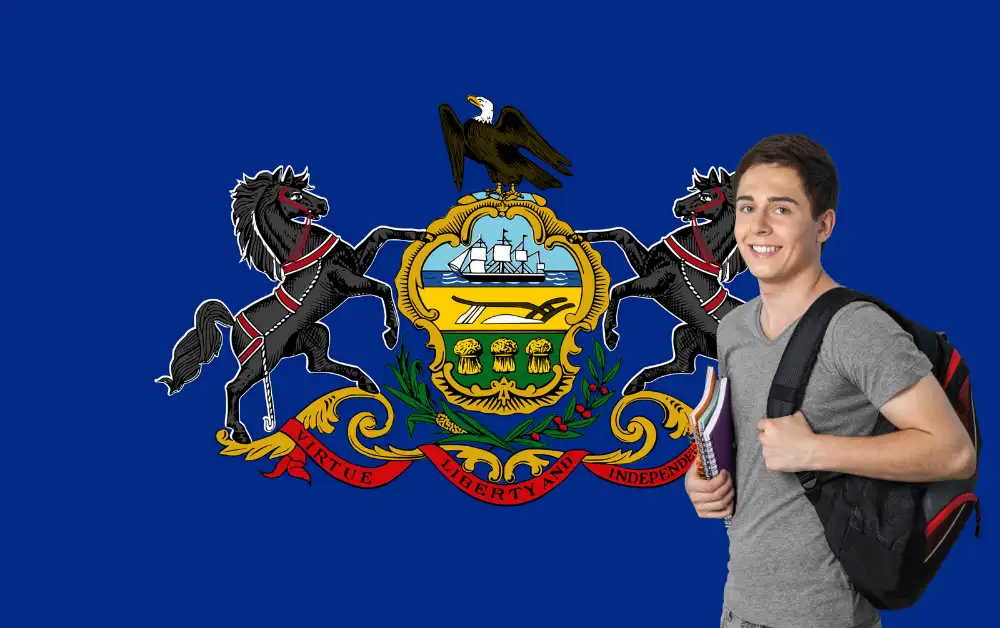
Pennsylvania Student loan options include both federal and state-sponsored borrowing programs designed to help residents and students attending Pennsylvania schools cover the cost of higher education; this guide outlines eligibility, major programs, costs, benefits, risks, and how to apply.
Who This Loan Is For
- Undergraduate and graduate students residing in Pennsylvania or attending an eligible Pennsylvania institution.
- Parents of students may apply for some programs (e.g., PA Forward Parent Loan, federal PLUS).
- Private and nonresident students may access certain options, but eligibility varies; verification requires checking the official program criteria.
Key Facts (At-a-Glance)
| Item | Details |
|---|---|
| Program Type | Federal loans (Direct Subsidized/Unsubsidized/PLUS); Pennsylvania-specific private loans: PA Forward Student Loans, Keystone Student Loans. |
| Interest | Federal: fixed rates set annually; Pennsylvania state/private: low, fixed rates, “sample/illustrative”; confirm latest on Keystone Student Loans official resource or PHEAA homepage. |
| Accrual | Subsidized federal loans: no interest in school; Unsubsidized/federal PLUS and private: interest accrues from disbursement. Capitalization occurs at deferment end and some repayment transitions. |
| Repayment Plans |
Federal: Standard, Graduated, Extended, and Income-Driven Repayment (IDR) plans. Pennsylvania private: fixed repayment, sometimes interest-only or postponed repayment. |
| Grace Period |
Federal: Typically 6 months after leaving school. Keystone/PA Forward: school-specific; check loan disclosures. |
| Deferment/Forbearance | Federal: multiple categories; private/state loan deferment varies—always verify terms. |
| Forgiveness/Discharge |
Federal: Public Service Loan Forgiveness (PSLF), Teacher Loan Forgiveness, Total and Permanent Disability, school closure. Pennsylvania state/private: forgiveness options rare. |
| Annual & Aggregate Limits |
Federal: set by loan type and study level (“sample/illustrative”; verify on federal tables). PA Forward/Keystone: set annual/aggregate max—review official loan documentation for current thresholds. |
| Fees |
Federal: origination fees (“sample/illustrative”; check annually). Keystone/PA Forward: “no application or origination fees.” |
| Cosigner Rules (Private) | Often required unless the borrower has sufficient credit and income; PA Forward/Keystone outline release criteria—see official details. |
Pros
- Federal loans offer strong borrower protections, predictable fixed interest rates, and eligibility for income-driven repayment (IDR) and forgiveness programs.
- Pennsylvania state loan programs like the PA Forward Student Loans and Keystone Student Loans have no application or origination fees and low, fixed rates.
- Some programs provide flexible repayment and require credit-building cosigners for students with limited history.
Cons
- Interest accrual while in school and during grace/deferment for many loans; capitalization can increase total debt.
- Private and state-specific loans generally lack federal protections (IDR, federal forgiveness, robust deferment/forbearance).
- Rigid underwriting for private/state loans—approval depends on credit and income (cosigner often needed).
Costs, Interest & Repayment Mechanics
- Interest is the cost of borrowing; annual percentage rate (APR) includes fees and compounding.
- Federal loans feature fixed interest (varies by year); private/state loans (Keystone, PA Forward) advertise low, fixed rates and no origination/application fees—verify rates and terms annually.
- Income-Driven Repayment (IDR) plans set federal loan payments based on income and family size. Private/state loans generally require fixed or interest-only payments; hardship options vary.
- Sample/illustrative repayment example: For a $10,000 loan at a 5% fixed interest rate, on a 10-year standard repayment plan, monthly payment would be about $106, and total paid about $12,727. These are general figures—always use the official calculator or disclosure for precise estimates.
| Example | Principal | Rate/APR | Plan | Monthly Payment | Total Paid |
|---|---|---|---|---|---|
| Sample Scenario | 10,000 (sample/illustrative) | 5% fixed (sample/illustrative) | 10-year Standard | $106 (sample/illustrative) | $12,727 (sample/illustrative) |
Application & Disbursement Steps
- Complete the FAFSA for federal and some state grants/loans. For PA Forward or Keystone Student Loans, apply through their official program pages.
- Review loan offers; for federal loans, complete a Master Promissory Note and entrance counseling. Private/state loan applicants undergo credit review; cosigners may be required.
- Approved funds are disbursed to the school; any remaining amount is refunded to the student based on the school’s financial aid policy.
Repayment, Deferment & Forbearance
- Federal loans enter repayment after a six-month grace period post-graduation or drop below half-time enrollment; most private/state loans have similar or shorter grace periods.
- Federal loans offer multiple deferment and forbearance options; eligibility requirements and interest policies are complex—refer to up-to-date federal guidance.
- Pennsylvania state/private loan deferment/forbearance policies are program-specific; consult the PHEAA homepage or loan servicer for current rules.
Forgiveness & Discharge Pathways
- Federal programs: Public Service Loan Forgiveness (PSLF) for government/nonprofit workers, Teacher Loan Forgiveness, and relief for permanent disability or school closure—qualification is specific and complex.
- Pennsylvania state/private loans rarely offer forgiveness. Exceptions may apply in case of death or severe disability, but check each loan’s terms and conditions.
Risks & Responsible Borrowing
- Federal and private loan default can damage credit, trigger collections, and result in loss of eligibility for additional aid.
- Carefully consider total cost, projected earnings, and available grant/scholarship aid before committing to any student loan.
- Make use of programs like Reminder Ready to track payment estimates and avoid missed payments; see Reminder Ready official information.
Alternatives & Comparisons
Side-by-Side Comparison
| Feature | Federal Loans | Pennsylvania State/Private Loans (Keystone, PA Forward) |
|---|---|---|
| Underwriting | Eligibility-based (FAFSA; no credit for undergraduate Direct loans) | Credit/income-based; cosigner often required for students |
| Rate Type | Fixed (set annually by federal law) | Fixed (competitive; “sample/illustrative”—verify with each cycle) |
| Protections | Extensive (IDR, forbearance, deferment, discharge option) | Some payment flexibility; fewer hardship protections vs. federal loans |
| Forgiveness Potential | Multiple pathways (PSLF, IDR endpoint, disability, school closure) | Very rare; check program disclosures |
Frequently Asked Questions
What is the difference between Pennsylvania student loan programs and federal student loans?
- Pennsylvania student loan programs (e.g., PA Forward, Keystone) are state-sponsored private loans with competitive fixed rates; federal student loans offer broader protections, income-driven repayment, and forgiveness options.
Do I need a cosigner for a Pennsylvania private student loan?
- Cosigners are often required for students lacking strong credit or income; check official guidelines for PA Forward or Keystone Student Loans for specific release criteria.
Can Pennsylvania student loans be used at out-of-state schools?
- Many PA state/private loans are available to Pennsylvania residents studying approved out-of-state programs, but eligibility and school approval vary—always confirm on official program sites.
What are the interest rates for Pennsylvania state student loans?
- Rates are set for each loan cycle and are typically fixed; current numbers are listed in disclosure materials—see Keystone Student Loans current rates or refer to the PA Forward Loan’s summary each year.
How do I apply for deferment or forbearance on a Pennsylvania state/private student loan?
- Borrowers should contact the loan servicer directly and review official forms; rules and available categories vary—see PHEAA homepage for details.
Can Pennsylvania student loans be refinanced?
- Some Pennsylvania loan programs offer refinancing options for graduates with eligible debt and adequate credit—visit the official loan program website for up-to-date offerings.
Where do I get repayment support and payment tracking tools?
- Pennsylvania borrowers can access tools like “Reminder Ready” for personalized payment estimates and balance alerts; see Reminder Ready official information.
Conclusion & Next Steps
- Pennsylvania students should explore federal student loans, state-sponsored options like PA Forward and Keystone Student Loans, and compare all terms before borrowing.
- To begin an application or get detailed up-to-date guidance, visit the PHEAA homepage or the Keystone Student Loans official resource. Review rates, disclosures, and eligibility carefully, and confirm any policy updates or repayment support tools.
- Always use official sources for new rules or deadlines, and reach out to your school’s financial aid office for school-specific procedures.